
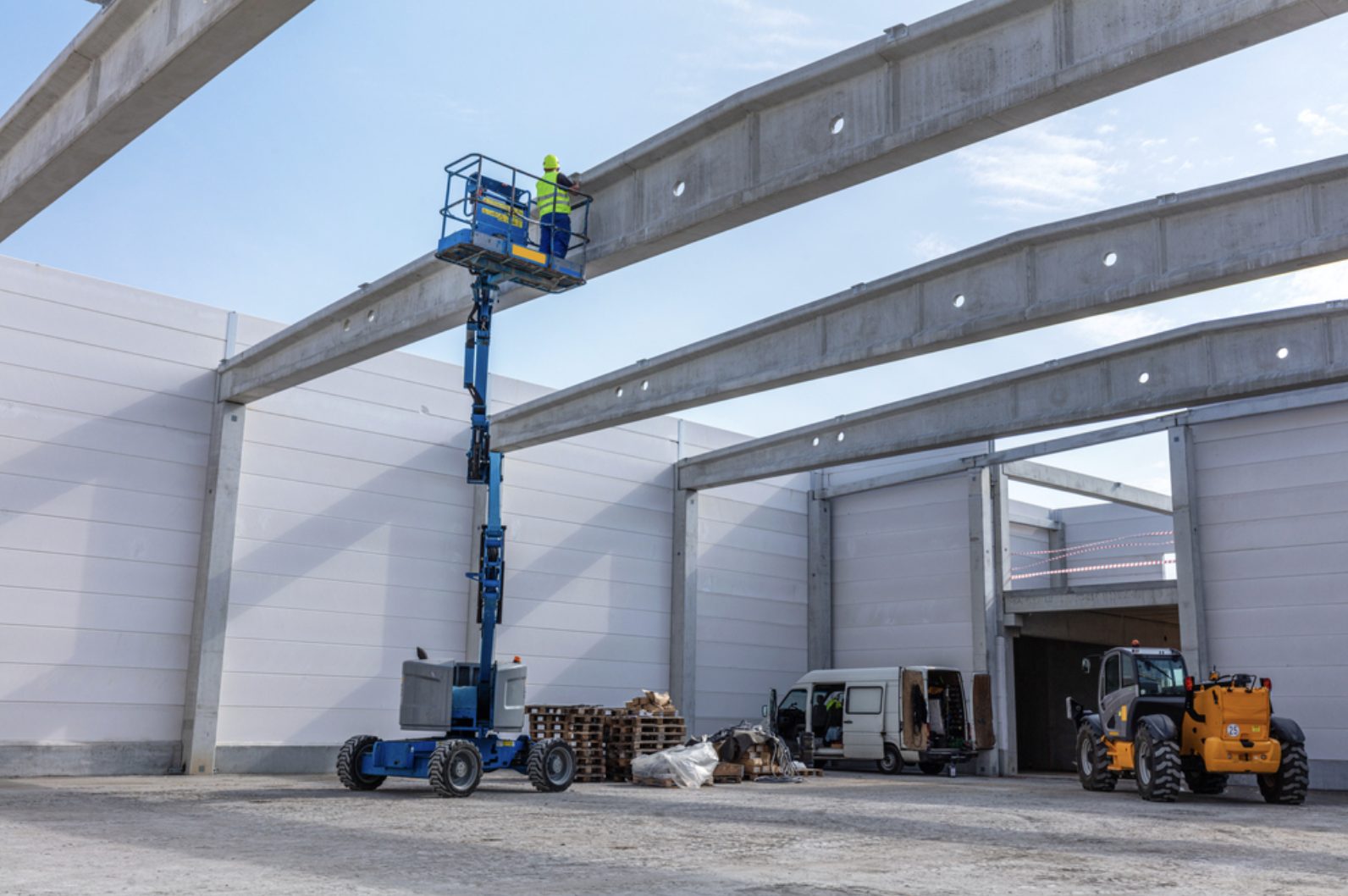
High-level cleaning is the cleaning of surfaces above normal working reach: racking, steelwork, beams, ductwork, light fittings, pipework and ceiling voids. It needs planned access equipment and trained operatives, which is why it sits outside a daily cleaning contract and usually runs once or twice a year.
It is also the only part of a building where standards can slip for years without anyone raising it, unlike floors, which get noticed, and washrooms, which get complaints. The underside of a mezzanine, the top face of a beam and the pipework above a production line are all out of sight from where people stand, so they come up in conversation only when dust starts landing on stock, when an auditor looks up, or when something fails.
Key Insights: What’s involved in changing cleaning companies?
- Cleaning of surfaces above normal working reach, generally taken as anything above around two metres.
- Separate from a daily cleaning contract, planned and quoted separately
- Governed by the Work at Height Regulations 2005
- Pole-fed vacuum systems can eliminate the need to work at height where reach allows.
- Dust on high surfaces is a fire, product and air quality risk before it is a tidiness one.
- Typically carried out every six to twelve months, with the interval set by what the process produces.
What Is High-Level Cleaning?
High-level cleaning is the planned cleaning of surfaces that a cleaner working from the floor, using standard equipment, cannot reach. In most buildings, that boundary sits somewhere around two metres, though there is no official height that defines it. The Work at Height Regulations 2005 deliberately set no minimum, because a fall from a low height can injure someone just as seriously as a fall from a high one.
High-level cleaning is priced and scheduled separately because it requires different equipment, insurance, and competence. It also usually involves different working hours because reaching above a production line or a loaded racking run means the area underneath has to be clear.
You will see it described in a few different ways depending on who is selling it. Commercial high-level cleaning usually refers to offices, retail and distribution sites, while high-level industrial cleaning denotes more demanding environments where deposits are process residue rather than ordinary dust. Internal high-level cleaning refers to work inside the building envelope rather than external cladding or gutters, and high-level vacuum cleaning refers to the pole-based method rather than the whole service. The work is broadly the same; the labels mostly reflect the setting.
Related reading: The UK Commercial Cleaning Standards Guide
What Does High-Level Cleaning Cover?
| Surface | What builds up | Why it matters |
| Racking, beams and steelwork | Process dust, fibres, cobwebs | Falls onto stock and packaging below; a fuel source where the process produces fine dust |
| Ductwork and extraction | Grease, dust, biological growth | Reduced extraction performance, and a fire path in kitchen extract systems |
| Light fittings and high-level glazing | Dust film | Light output drops as the film builds, which affects both working conditions and energy use |
| Sprinkler heads and detectors | Dust | Risk of obstruction and false alarms; method must be agreed with whoever holds the fire risk assessment |
| Pipework, cable trays and mezzanine undersides | Dust and debris | A dust reservoir that sheds back into the space every time something vibrates |
| Ceiling voids and soffits | Dust, pest debris | Air quality, and a frequent finding in food and pharmaceutical audits. |
The list looks long, but most sites only need part of it. A distribution warehouse with palletised stock and no process has a straightforward job: racking, steelwork, lighting and the beams. A food production unit with extraction, high-care zoning, and exposed product is much more involved, and the scope has to be worked out area by area rather than applied across the building.
One thing worth settling early is who owns the fire systems. Sprinkler heads and smoke detectors are life safety equipment, and dust on a detector head is a genuine cause of unwanted alarms. They still need to be kept clean, but the method should be agreed with whoever holds the fire risk assessment rather than decided by the cleaning contractor on the day.
Why Does High-Level Cleaning Get Skipped?
Almost every site that has fallen behind on high-level cleaning has done so for the same handful of reasons:
- Nobody can see it. Dust accumulates gradually, and from below it can look like a shadow. By the time it is obvious from the floor, there is a substantial amount of it.
- It is not in the daily specification. Where a task is not written down, against an area and a frequency, nobody owns it. High-level work rarely appears in a daily contract, so it falls between the cleaning contractor’s scope and the site’s maintenance plan.
- It needs the space clear. A pass over a production line or a loaded racking aisle means stopping or moving what is underneath. That makes it a scheduling problem as well as a cleaning one, and scheduling problems are easy to push into next quarter.
- It arrives as a separate quote. Because it is priced separately rather than absorbed into a monthly figure, it reads as an optional extra rather than as part of keeping the building to standard.
The practical consequence is that deferral compounds. A surface cleaned on an annual cycle takes a single visit. The same surface left for four or five years can take a week to clean, and in the worst cases, the deposit has bonded so firmly that it needs to be stripped rather than vacuumed.
Our daily warehouse cleaning checklist puts high-level work on a six- to twelve-month cycle but stops there. How that work is actually done is what the rest of this guide covers.
How Is High-Level Cleaning Done Safely?
Most descriptions of high-level cleaning start with the equipment. But the Work at Height Regulations 2005 set out an order of preference, and the choice of equipment follows from it.
The order is: avoid working at height where the work can reasonably be done another way. Where it cannot be avoided, use equipment or an existing safe place of work that prevents a fall. Where a risk of a fall remains, use equipment that minimises the distance and consequences.
Applied to cleaning, this produces a hierarchy.
| Approach | What it is | Where it fits |
| Pole-fed vacuum systems | Modular poles with a vacuum head and inspection camera, operated from the floor. | First choice, because the operative never leaves the ground. Reach and surface type set the limit, not safety. |
| Mobile elevating work platform | Powered platform with the operative working from a guarded basket | Where reach, access angle, or surface type rules out the use of poles. Requires trained operators. |
| Mobile access tower | Assembled tower with guardrails and a working platform | Static or detailed work over a small footprint. Requires trained assembly. |
| Fixed scaffold | Erected for the duration of the work | Extended or complex programmes, or where floor loading rules out a platform. |
Working down that table means accepting more risk, more planning and usually more cost, so there should be a reason each time. If a contractor proposes a platform for work that poles could reach, it is fair to ask why.
Four things sit behind the method and are worth checking before the work is booked.
Thorough Examination Records
Under the Lifting Operations and Lifting Equipment Regulations 1998, lifting equipment used to lift people must be thoroughly examined at least every six months, as must lifting accessories. Other lifting equipment is on a twelve-month cycle. Ask to see the current report for the platform coming to site, which is a different document from the operator’s training certificate.
Floor Loading
A platform on a mezzanine, a suspended slab, or a basement deck is a structural question before it is a cleaning one, and it needs to be answered by someone qualified to do so.
Isolation and Permits
Live racking, conveyors, lighting circuits, and sprinkler systems all require agreement before the method is finalised. This is usually where a job slips, because the permit was not arranged and the team arrives at a line that cannot be stopped.
Containment
Dislodged dust goes somewhere. Working above open product, stock or machinery changes the method, and the specification should state what happens to what comes down, including who cleans the floor afterwards.
Where work at height is involved, IPAF certification covers powered access, and PASMA covers mobile towers. Our operatives at MCS Cleaning hold IPAF, PASMA, and CSCS training, and the company is Safecontractor-approved and ISO 9001 and ISO 14001-certified.
Contact us to arrange a free, no-obligation quotation.
What Equipment Is Used for High-Level Cleaning?
High-level cleaning equipment has changed more in the last fifteen years than almost anything else in commercial cleaning, largely because of pole systems.
High-Level Vacuum Systems
High-level vacuum systems consist of modular carbon fibre poles connected to an industrial vacuum unit, with a cleaning head at the top. Reach varies by system, but most extend well beyond ten metres. The detail that makes them work is the camera: a small inspection camera sits at the head and feeds a screen at floor level, so the operative can see the surface they are cleaning rather than working blind. It also produces before-and-after footage as a by-product.
Filtration Class
Industrial vacuum units are classified by the dust they are rated to capture, and the appropriate classification depends on what the process produces. Where a site handles substances covered by COSHH, such as hazardous dust, the filtration specification should be part of the risk assessment rather than left to whatever unit turns up.
Soft Brushing and Dry Methods
These methods are used where moisture would worsen the problem. Electrical equipment, certain food environments and anything where damp dust could set into a crust all point away from wet cleaning.
Wet Methods and Encapsulation
Wet methods and encapsulation come in when deposits have bonded and will not lift with dry methods. Grease in extract ductwork is a common example. Using wet cleaning methods directly above boxed stock or exposed goods poses containment risks, so the process requires careful planning rather than a last-minute decision on site.
Verification
Unlike standard visual inspections, high-level cleanliness needs verifiable confirmation, such as surface sampling, camera footage, or another pre-agreed evaluation appropriate for the environment. Establishing the verification standard before starting work ensures clear sign-off, which is essential in regulated settings where audit documentation is required.
How Often Should High-Level Cleaning Be Done?
No regulation sets a frequency. The interval comes from what the process produces, what the surface sits above, and what the site has to prove to anyone auditing it.
| Setting | Typical interval |
| General storage and distribution | Annual |
| Manufacturing with process dust | Every six months, or more often where the assessment calls for it. |
| Food production and packing | Set by the certification schedule, often quarterly, in high-care areas. |
| Kitchen extract ductwork | Set by BESA ventilation hygiene guidance and the fire risk assessment. |
Treat those as typical rather than prescribed. The more useful approach is to schedule the first clean, record what was actually found, and set the interval from the evidence. A site that turns out to have very little accumulation after twelve months can extend. A site where the racking is coated again within four months has learned something important about its extraction, not just its cleaning.
Where dust is combustible, the frequency becomes a control measure. The Dangerous Substances and Explosive Atmospheres Regulations 2002 require the risk from dangerous substances to be assessed and controlled, and HSE’s guidance on the safe handling of combustible dusts explains how everyday materials including wood, grain, sugar, certain metals and many synthetic organics can form a combustible cloud. In those settings, the cleaning interval should be set by the DSEAR assessment and nothing else.
What About Racking, Ductwork and Mezzanines?
Three parts of the job come up often enough to be worth treating separately.
Racking
The question that sets both the price and the programme is whether stock comes off. Cleaning a cleared run is straightforward. Cleaning around loaded racking is possible and often the only realistic option, but it is partial and should be described as such rather than quoted as equivalent. The other half of the problem is underneath: the floor beneath the bottom beam and the space behind the uprights collect dust that never gets reached by a scrubber-drier, and most specifications do not mention them.
Ductwork and Extraction
Where local exhaust ventilation systems support dust control, Regulation 9 of COSHH mandates that control measures are regularly maintained, examined and tested, with HSE guidance specifying thorough examinations at least every 14 months. While cleaning ductwork and servicing system equipment are distinct tasks, coordinating them in a single maintenance plan produces better results than treating them separately.
Mezzanines
On a mezzanine, the work is the underside of the deck, the support steel, and the top faces of any pipework or cable trays running beneath it. Mezzanines also bring the floor loading question into play, because a platform parked on one is a structural decision.
What Should You Ask a High-Level Cleaning Contractor?
Five questions, all fair to ask at quote stage:
- What access method are you proposing, and why that one? If it is not the pole system, there should be a reason connected to reach, surface or access rather than habit.
- Can you produce the current thorough examination report for the platform? Not the training certificate, but the machine’s examination report.
- Who holds the IPAF or PASMA certification? The company holding a membership and the on-site operative holding a current card are different.
- How will the work be verified, and what does the record show? Camera footage, a signed inspection, a sampling result, something.
- What happens to the dust that comes down? Including who cleans the floor, and whether that is included in the quote.
Related reading: 6 Signs Your Cleaning Contractor Is Underperforming
High-Level Cleaning FAQs
What is high-level cleaning?
High-level cleaning is the cleaning of surfaces above normal working reach, including racking, beams, steelwork, ductwork, pipework, light fittings and ceiling voids. It requires planned access equipment and trained operatives, which is why it is scheduled and quoted separately from a daily cleaning contract.
What does high-level cleaning include?
It usually covers racking and structural steelwork, ductwork and extraction, light fittings and high-level glazing, pipework and cable trays, mezzanine undersides, and ceiling voids. Sprinkler heads and detectors can be included, but the method needs to be agreed with whoever holds the fire risk assessment. Exactly what is included depends on the building and the process, so scope is set area by area.
How high is high-level cleaning?
There is no official height. In practice, the boundary sits around two metres, where a cleaner working from the floor with standard equipment can no longer reach safely. The Work at Height Regulations 2005 set no minimum height, because the duty applies wherever a fall could cause injury.
How often should high-level cleaning be done in a warehouse?
Most general storage and distribution sites operate on an annual cycle, and manufacturing sites with process dust usually move to a six-monthly or shorter cycle. Food production often runs to a certification schedule instead. Where dust is combustible, the interval should be set by the DSEAR assessment rather than by a standard frequency.
What equipment is used for high-level cleaning?
Pole-fed vacuum systems are the most common, using modular carbon fibre poles with an inspection camera and a vacuum head operated from floor level. Where reach or surface type rules those out, the work moves to a mobile elevating work platform, a mobile access tower, or a fixed scaffold. The filtration class is chosen based on the process’s output.
Do you need to empty racking for high-level cleaning?
Not always, but clearing it produces a materially better result. Cleaning around loaded racking is possible and is often the only practical option on a working site, though it leaves areas that cannot be reached. If racking stays loaded, the quote should say what is excluded rather than implying full coverage.
Is high-level cleaning part of a normal cleaning contract?
Rarely. Daily contracts cover work that can be done from floor level during a normal shift. High-level cleaning needs access equipment, specific training and usually a clear area, so it is typically scheduled as a periodic task within the contract or quoted as a separate programme. Either way, it should appear in the specification with a stated frequency, rather than being left to be arranged when someone notices.
Who is qualified to carry out high-level cleaning?
Anyone carrying out work at height must be competent for the method being used. For powered access, that means IPAF certification; for mobile towers, it means PASMA. The contractor should also be able to produce risk assessments and method statements for the work, COSHH assessments for anything brought on site, and the current thorough examination report for any lifting equipment.
MCS Cleaning carries out commercial high-level cleaning across factories, warehouses and production sites in Leicester, Nottingham and Berkshire, with IPAF and PASMA-trained operatives and the method agreed before the work is scheduled.


